Prayer
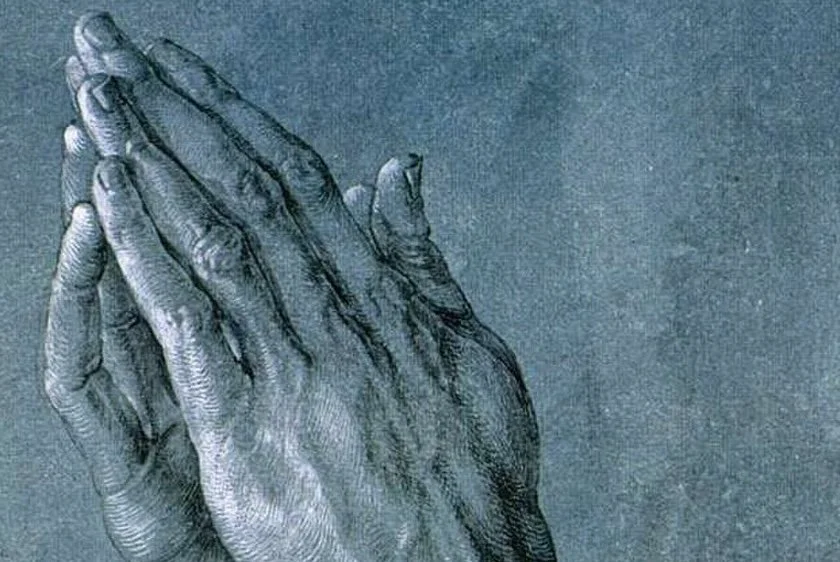
Detail from Albrecht Dürer, Betende Hände. Wikimedia Commons.

After last week’s post I fear you might be sensing a churchy trend. Don’t worry; I’m not about to proselytize you. This is a response to poetry that I think you should read—it’s like an OWW entry that responds to more than one phrase.
I have an uneasy relationship with the poem Prayer by Marie Howe. Here is it, in full (audio available at the link):
Every day I want to speak with you. And every day something more important
calls for my attention—the drugstore, the beauty products, the luggage
I need to buy for the trip.
Even now I can hardly sit here
among the falling piles of paper and clothing, the garbage trucks outside
already screeching and banging.
The mystics say you are as close as my own breath.
Why do I flee from you?
My days and nights pour through me like complaints
and become a story I forgot to tell.
Help me. Even as I write these words I am planning
to rise from the chair as soon as I finish this sentence.
If you listen to the audio, you may be struck by how petulant the first part sounds. It’s the sort of poem I might give up on. If you’re going to counterpoint a mundane earthiness with something transcendent, you’d better nail that transition. And she does, somehow. The mystics say you are as close as my own breath. What a line—a single calming exhalation that quietens the distractions of the previous two long sentences.
Without straining, Howe lays bare a plaintive need for a connection, even as she fights against that need and believes on some level that it might not even be possible. My days and nights pour through me like complaints—who among us has not looked back with pain on time not even spent but just neglected—and become a story I forgot to tell. Oh man. If you don’t get what she means here, I envy you. The sense of a failure that is entirely self-earned, in fact a failure that’s stubbornly sought out while spurning all possible help from whatever source. That’s a bitter feeling, and it’s perfectly evoked here, and the poet’s only recourse is to ask for help and admit that her focus can’t even extend to waiting for a response to that ask.
Although the poem may not even be describing a prayer to a God (it’s consistent with a desire for self-reflection and self actualization) I admit it resonates for me because it’s how I feel both about God and about my own work. It’s strangely comforting to know that another has a similar struggle, but the unease arises because it’s such a shabby and unflattering description of a human mind: seeking more, unable to master or even influence itself. It seeks a helper that is outside the mind doing the thinking and also somehow within the same being. It’s hard to see this as aspirational, particularly if you don’t believe in God. But I’ve described elsewhere how I think the mechanics and terms of faith are beneficial whether or not God exists (and that this situation is itself evidence that some ordered, transcendent, purposeful will is involved in human existence). This poem is another reminder of how secular faith keeps re-approaching the old terms of religious belief—specifically the need for both communion with another and acknowledgement of that which we can’t consciously control. Prayer does both those things, extremely well. It’s simply uncomfortable to see one’s weaknesses illuminated so clearly.
P.S. In the act of looking up links for this post I misremembered the poet’s name and came across Praying, by Mary Oliver. I now think of it as a companion piece, an alternative to Howe’s strident stressing, a reminder of what the first step towards selflessness and abstraction can look like. It’s not an expressive prayer, but it captures that inclination towards thinking you can converse with another of which you are a part. It’s the prayer of the first, formless intention to listen:
It doesn’t have to be
the blue iris, it could be
weeds in a vacant lot, or a few
small stones; just
pay attention, then patch
a few words together and don’t try
to make them elaborate, this isn’t
a contest but the doorway
into thanks, and a silence in which
another voice may speak.