OWW 5: Hamnet
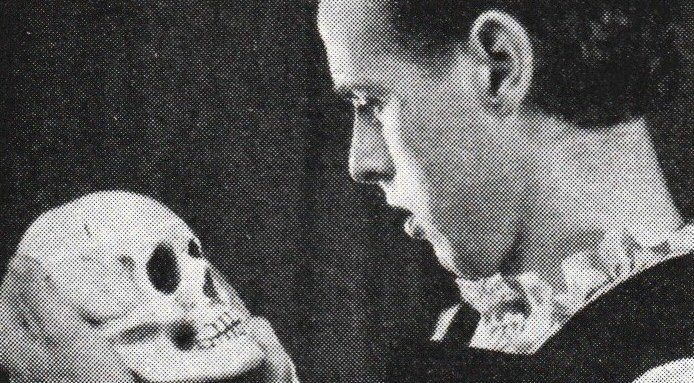
The space between two faces. Image: Wikimedia
Maggie O’Farrell is having a moment. She has published successful and critically-acclaimed novels for over a quarter-century, but her 2020 novel Hamnet hit a cultural moment, inspiring a stage play and then an Oscar-winning movie. It’s a hard story for any parent to experience, but it’s extremely well-done. One phrase in particular has lodged in my memory, prompting the mix of admiration and envy that means it’s a good candidate for Other Writers’ Words.
Spoilers for the book and, I guess, the well-known biography of William Shakespeare:
It’s 1596, and Shakespeare’s son has just died. Let’s back up slightly. William, the son of a disreputable Warwickshire glover, works as a Latin tutor to pay off his father’s debt to a local family. Instead he, shall we say, encounters Agnes, the beguiling eldest stepdaughter of that family, 8 years older than he. Agnes corresponds to the historical figure Anne Hathaway. They wed. A daughter is born a few months later. William chafes under his father’s influence in Stratford and eventually relocates to London. By 1596 he’s written and performed in several of his well-known early plays, including Henry VI, Richard III, A Midsummer Night’s Dream and Romeo and Juliet. He and Agnes have the daughter (Susana, age 13) and twins Hamnet and Judith (age 11). [1] The parents regret their separation but feel the squalor of London is unsafe for the children, particularly Judith, who has been weak since birth, so Agnes remains with them in Stratford. The plague comes. Both Judith and Hamnet are taken ill. Only Judith recovers.
William hears of the illness by letter and rushes home, arriving in time for Hamnet’s burial. Afterwards, both Agnes and William are numb with grief, though they manifest it in different ways. Agnes assumes that in the aftermath of that tragedy the four survivors will band together. She realizes that William is preparing to depart back to London, to take up his place with his company of actors, to continue staging and writing plays. She is irate; her grief flashes into anger. She confronts him, and this is how O’Farrell describes it:
“‘You speak of your company,’ she says into the space between their faces, which is so narrow they must be breathing each other’s breath. ‘You speak of your season and your preparation but none of these is the proper reason.’”
I love how Agnes’s words capture the hissing anger that is nearly the only emotion she can experience at this point in the story. I think the dialogue is appropriate and powerful, but the real juice comes from the connective part: the reference to “the space between their faces” filled with “each other’s breath”. That rhyme is perfect: two things that resemble each other yet are not only different but practically opposites. All at once the description highlights their physical nearness and their fundamental separation. It hints that Agnes knows she is not really communicating with her husband, she is merely speaking towards him. It captures their emotional and physical closeness: they have shared their bodies to make children, one of whom now lies dead, and their breath still commingles in an attitude of intimacy. It carries a suggestion that their connection to each other is unwanted at this particular moment; that they experience this closeness as an imposition. It evokes the continued vitality of these two bereaved parents—still breathing in sharp contrast to the recently buried son. And (to my mind) it hints at the famous staging of the yet-to-be-written play Hamlet, in which the space between two faces contains all the contemplations of mortality.
Not bad for a description of a marital spat.
At this time the names Hamlet and Hamnet were considered interchangeable.