OWW 6: James and ruin
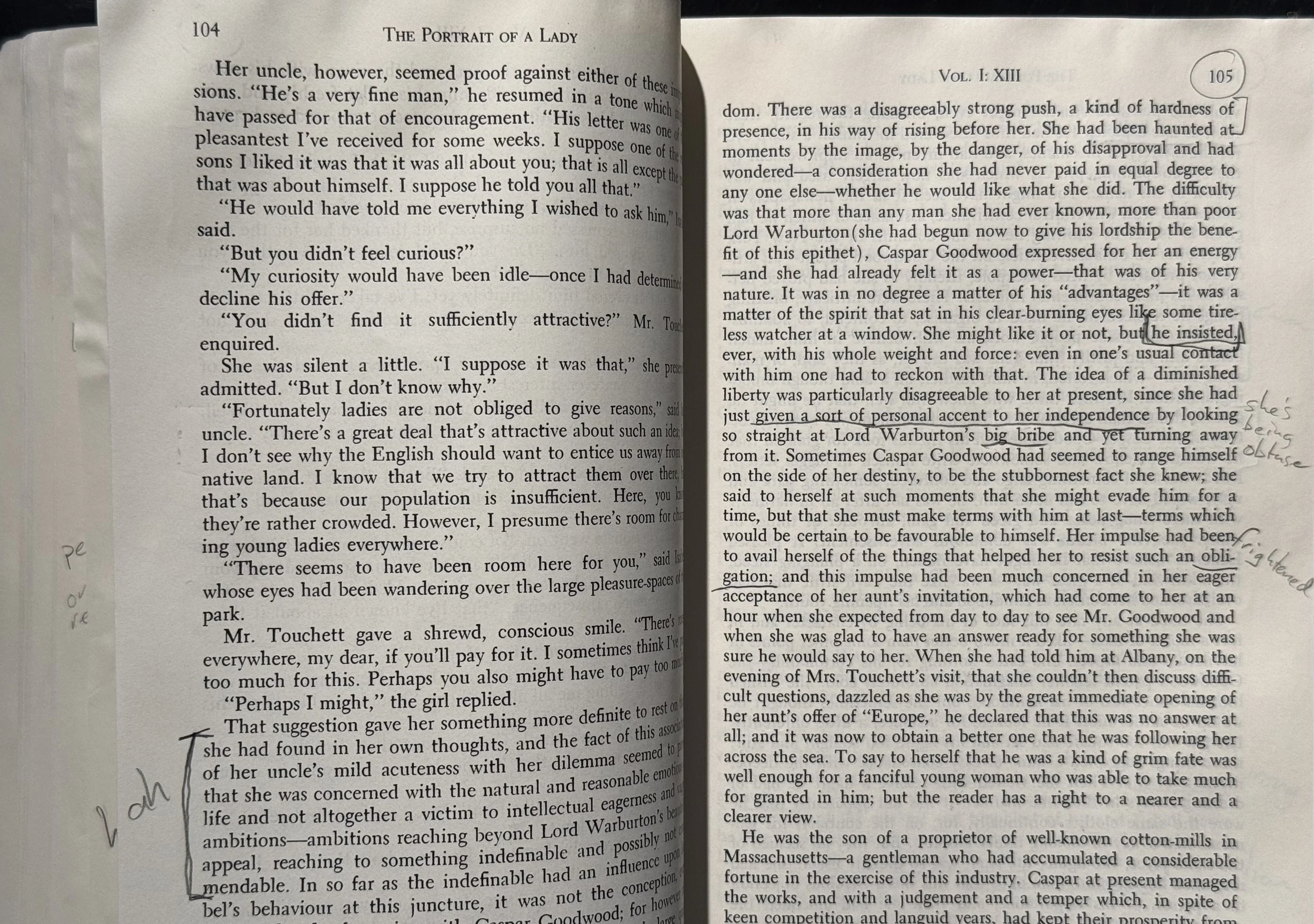
Marginalia. My photo.
It’s a strange quirk of my personal history that as I’ve come to own far more books than I used to, I also write in them far less than I used to. I don’t think I can blame screens for this, either—my graduate school experience created a kind of firebreak that temporarily blocked my long-smoldering habit of reading for fun.
When I got back to reading circa 2010, I wasn’t in academia anymore and just wasn’t as motivated to record my responses, even when reading on paper. I’m honestly not sure whether to regret this shift.
But in any case this history means that if I go back to my old books, I can find phrases and moments that struck my fancy a quarter-century ago. One of them is the subject of this sixth entry of Other Writers’ Words.
Because the phrase is by Henry James, I need to provide some context first.
It concerns Ralph Touchett, one of the interested parties in The Portrait of a Lady. He’s introduced alongside a strikingly handsome and confident friend, and the contrast is not kind to Ralph.
“Tall, lean, loosely and feebly put together, he had an ugly, sickly, witty, charming face […] He looked clever and ill…“
He has tuberculosis. At this point in his story he has accepted this fact and all the losses that come before the final loss; in particular he realizes he will have no chance to distinguish himself professionally or personally as his father has done. Despite this he presents a cheerful face, and his friends believe that his cheerfulness is a sign that he (wrongly) expects to recover from his illness.
Optimism would certainly be a valid psychology. But James doesn’t go that way with the character. He makes clear that Ralph is aware of his impending doom, and wears this mood like a disguise. Here’s the phrase:
“His serenity was but the array of wild flowers niched in his ruin.“
It’s possible I’m overreacting, but I think “niched” is a choice of absolute genius here.
Of course, on the surface level it’s a lovely image: the spray of lively color contrasting the rundown bulk. It’s a very effective visual and a neat metaphor for his noticeable but ultimately insubstantial presentation on Ralph’s part.
But the word choice amplifies the image. “Niched” evokes associations that “set” or “placed” wouldn’t, all of which resonate with and strengthen the metaphor:
Chinks and crannies, of the sort that would occur in a ruin
A space offering protection for a delicate or fragile thing
An ecological setting where an organism can thrive—and outside of which it can’t
Alcoves filled with statues: figures that witness but can’t partake in what happens around them
Several links with burials and mausoleums: the recess in a headstone where flowers can be placed, or more commonly the resting place for an urn (or, in earlier times, a corpse)
I’m sure I’m overlooking other resonances as well.
Furthermore “niched” is a legitimate verb (meaning to place in a niche), but it also suggests Ralph put those flowers there on purpose for the effect; they’re not simply a natural feature of his character.
Finally, it’s a subtle thing but using “wild” as an adjective (“wild flowers” instead of “wildflowers”) also reinforces the effect for me: it contrasts the thriving, unconstrained plant life with Ralph’s cultivated and limited physical form. I don’t want to read too much into this because the term “wild flower” was about 10x more common than “wildflower” until the 1930s, and didn’t become less common until the 1970s.* But the effect is real whether or not James meant it.
All in all, “niched” carries quite an impact for a six letter word, and is a worthy target of my admiration and envy.