Nine eleven at twenty five
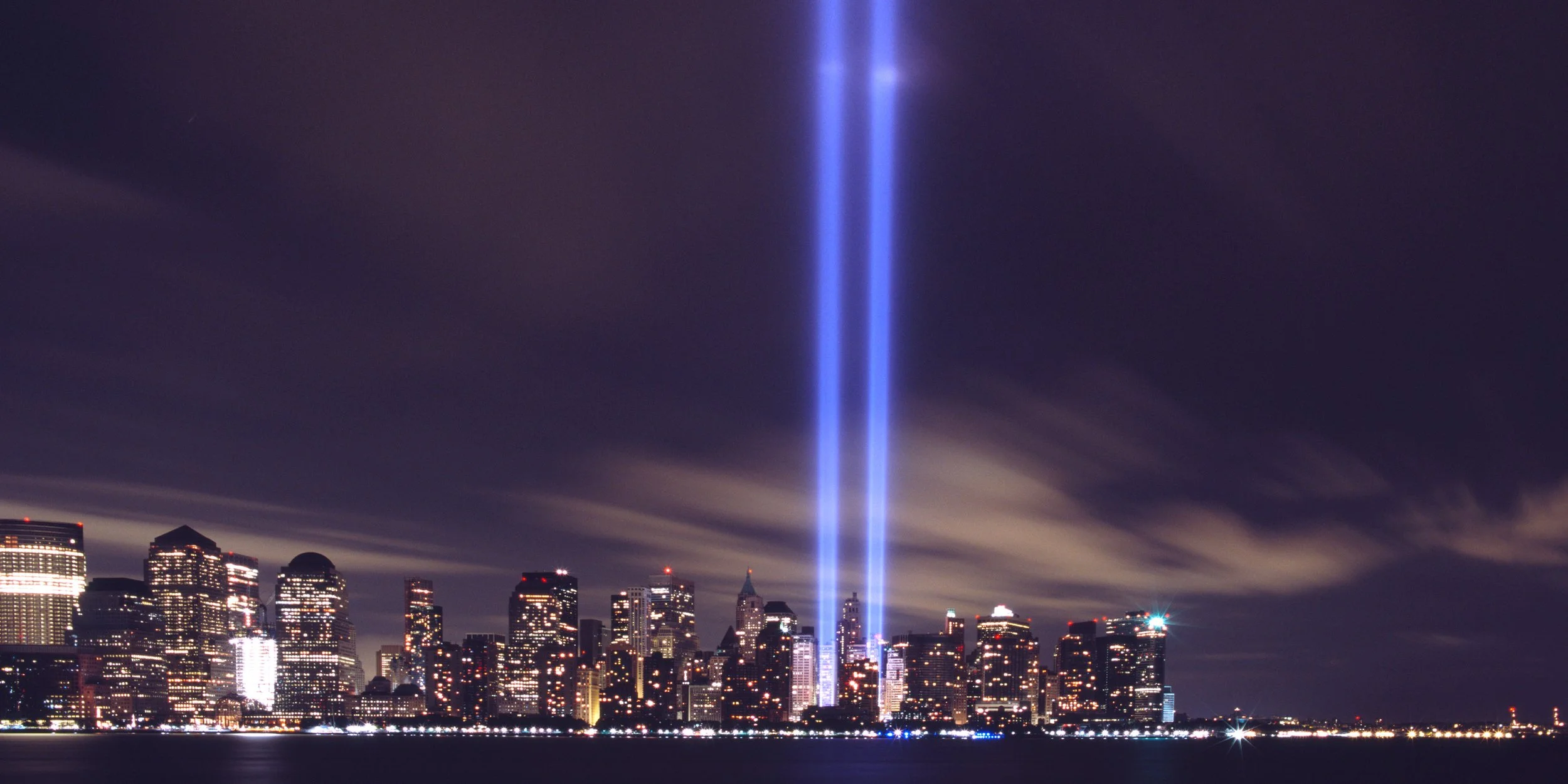
Tribute in Light. Photo: Robert Vizzini, Municipal Art Society of NY
In those days I used to sleep late. Today, I have two kids and can’t, but back then I had 36 kids and still could, because I was only two years older than they, and an RA, and no college student ever demands anything of another before 10am. This was at Cornell University in September of 2001. I was a sophomore: twenty and a half years old.
We RAs moved into the dorms before our kids—we called them our kids, which was ridiculous in the way that so many things about the past are unselfconsciously ridiculous. When they arrived in mid August we did the spiel: I’m here to help you. This time last year I was sitting where you are. I’m in charge of this unit; these 24 rooms. I’m not the police. If you screw up, don’t be afraid to ask me for help. It’s not that bad. Don’t do things in here that demand my involvement, and I won’t get involved. This time last year my RA gave me this spiel, and it helped me.
It seems to help my kids too. A few weeks and there’s no drama that reaches me. 18 boys, 18 girls. Good kids.
Now it’s 9am and I’m asleep, because I was young and an English major and had only very clear responsibilities. The nebulous, unattainable responsibilities hadn’t yet arisen. A scared boy pounds on my door. Did I see the news? I did not.
The tower’s on fire. Plane crash. Bad accident. My kid’s kid brother goes to Stuyvesant High School; it’s right there and the school is an evacuation point. I say that’s good—the school’s OK. But the brother gets off at World Trade Center station, right around this time. Brother doesn’t have a cellphone—neither do I. Few do. Calls from the wall phone go unanswered, or go through to people who know no more.
Seems like half my kids are from NYC or Long Island. Cornell, after all. Too many contacts in the danger zone. Some kids are in class, unaware or uncertain. Classes disband. No one can pay attention to anything else.
A second plane. A plane at the Pentagon. A missile? A plane. These aren’t accidents. Refreshing CNN.com. Calling my mother. It’s her fifty-first birthday. A plane crash in the middle of nowhere Pennsylvania. One of my girls is from middle of nowhere Pennsylvania and thinks the plane hit her house. Can’t rule it out. Can’t rule anything out. The sky is free of planes.
I walk into the common room and there’s a tableau of faces turned towards me but looking up above my head, at a television. I crane my neck around and up and see a pair of burning towers. Then one collapses and it’s dizzying. I look at the faces and see an older lady, a custodian, put her hand to her mouth. Ten years later, as our government kills the man most responsible for this, Hillary Clinton makes the same gesture.
This is the Kobayashi Maru of RA situations. I’ve known these kids for less than a month. The first nebulous, unattainable responsibility arises: make sure my kids are all right. Of course, they are—they’re in their dorm, 175 miles from the crash sites in NYC. But of course they’re not, because the world just ended and we didn’t know what would happen after that. How do you even address the problem, let alone protect against it? My boss suggests just keep them in view, don’t let them be alone, and so we go as a huge group to the dining hall, talk of other things. The ones most at risk are hardest to reach.
One boy’s uncle worked in the towers but got out. The middle-of-nowhere Pennsylvania crash did not actually hit the girl’s house. The younger brother was OK. None of my kids lost anyone. But of course many did, and we all lost the world we grew up in, the world as it was from our 10 to 20, where we won wars both cold and hot, where we set the agenda, where we didn’t have to think of tragedy. This was a privilege, of course. Maybe it was never sustainable.
That night we all stood on the Arts quad with candles and listened to words about community. We felt like a community; we really did. We donated blood. We learned from friends, classmates, acquaintances, of the unexpected losses lodged in unexpected places. We confronted the randomness of tragedy; how it missed the likely and struck the safe: the classmate’s cousin who had a job interview at Windows on the World that Tuesday morning.
My father went to Manhattan a few days later and picked broken windowglass off the street. It sits behind frame glass in my childhood home, on a matte inscribed “Remember.” I don’t often think of that day, but it defined the conditions of my adulthood. There were horrors before, but the horrors of that day, and the ones we perpetrated afterward, are the ones I know. It was a catastrophe in the Greek sense: a turning point, the end of a drama, in retrospect maybe the end of The End of History. The worst thing is, it worked. We were terrified. I think we still are. Despite the heroes and the sacrifices, then and after, we wrecked ourselves in response. We fought terror and it became the only thing that we could think about. I hope the ones who didn’t know it can forget. And I hope the sky is never free of planes again.
I never went up the towers. I stood at their base one time and craned my neck to look. I remember feeling dizzy, like their height could show the rotation of the earth; their tops whipping through the air like fishing rods. My younger brother spent a New Year’s Eve there not long before they fell; he told me he felt dizzy looking down at bursting fireworks.
Wer mit Ungeheuern kämpft, mag zusehn, dass er nicht dabei zum Ungeheuer wird. Und wenn du lange in einen Abgrund blickst, blickt der Abgrund auch in dich hinein.
“Whoever battles monsters should take care that in doing so he does not become a monster himself. And if you look long into an abyss, the abyss looks also into you.”
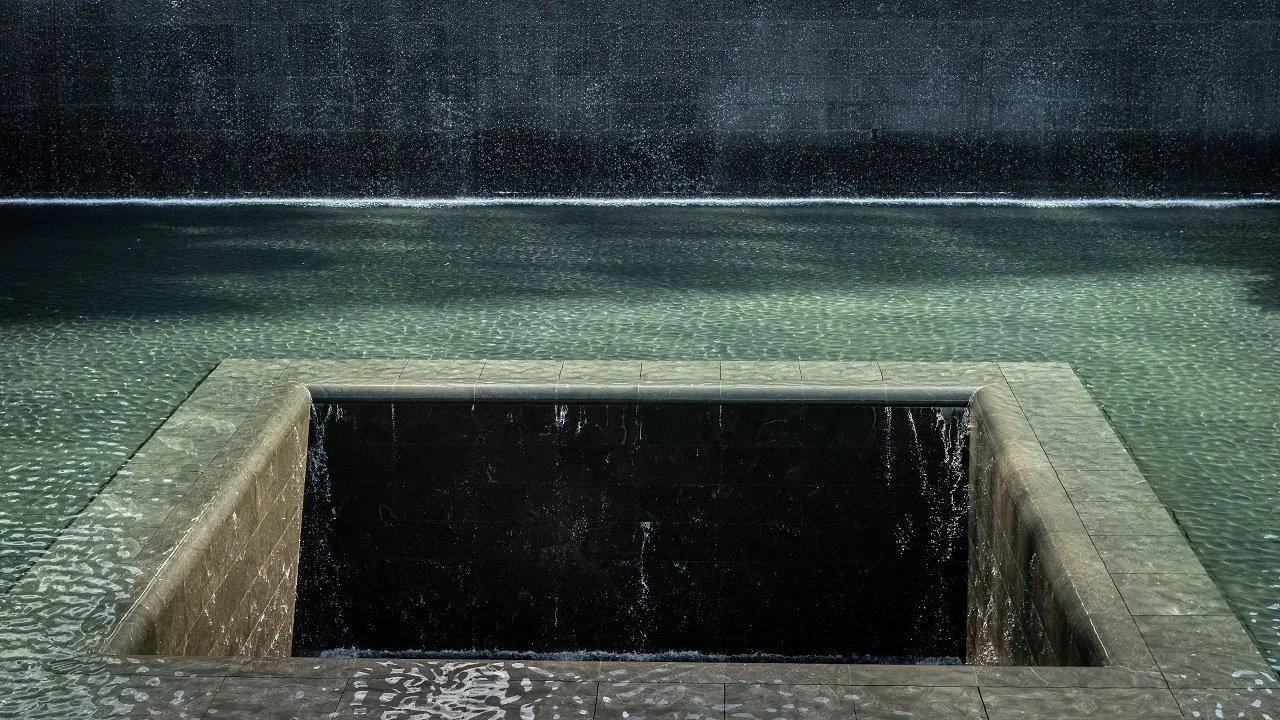
9/11 Memorial Pool. Photo: Dan Winters