Timelessness
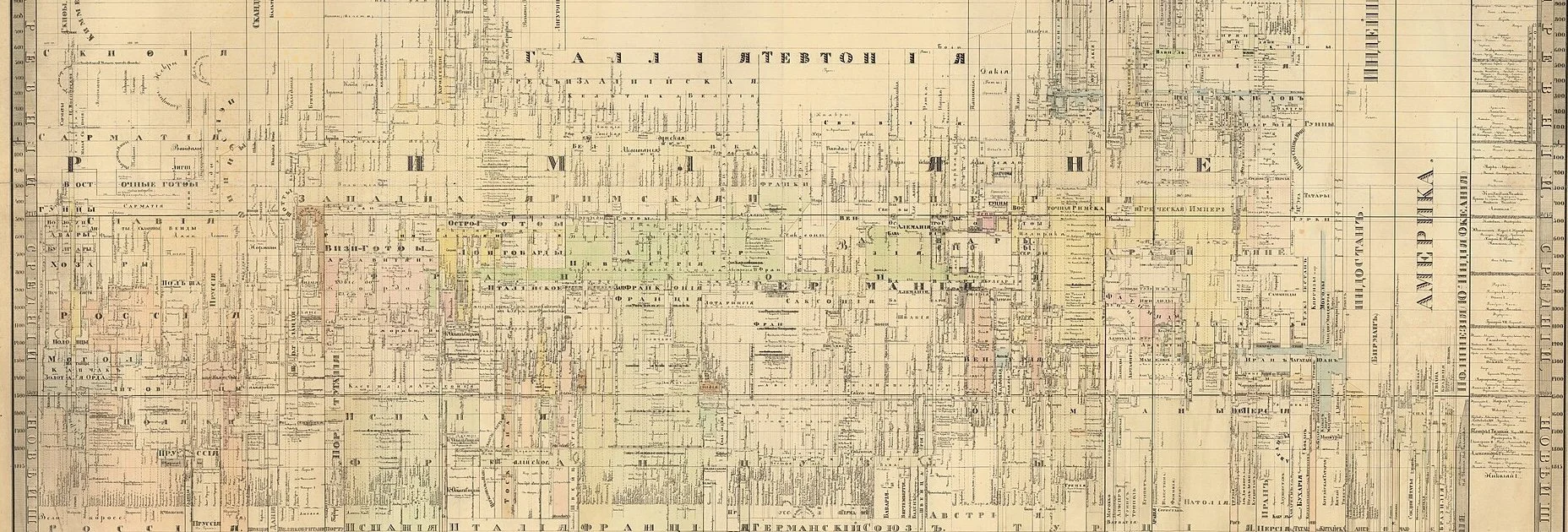
Detail of Russian timeline of world history, 5508 BC to 1839 AD. Image: Wikimedia

Since my post on this subject a few weeks ago, I’ve been thinking about what makes a particular piece of writing timeless. This is one of those annoyingly broad questions that has completely contradictory answers depending on how you define the terms. So I can say up front: there’s no such thing as timeless writing, and also any writing you can understand is timeless.
Maybe some examples would be helpful. This piece from yesterday’s Atlantic is a good example of what I’ll call “timely” writing: one with meaning tied to a particular event in a particular context. Specifically, it refers to an October 10th incident where a celebrity entered a toy store and later got into a dispute with staff about whether a particular animatronic bird was for sale. The Atlantic article riffs on this, referencing Poe’s “The Raven,” and proposing a mutually beneficial arrangement between someone who wants a bird but was unable to obtain one, and someone who desperately wants to get rid of a bird.
Your mileage may vary as to whether this is actually funny; to me it’s the sort of thing that prompts me to think “that’s funny” without any outward sign of mirth.
But of course any piece of writing has both timely and timeless parts in some ratio. A thing that becomes known as “timeless” is a thing whose central point is still understandable to a later reader (perhaps it’s better to say that is has a plausibly central point that is still comprehensible later; the true original central point may have shifted or been lost).
So timelessness is a spectrum. One extreme would be something like the chat that accompanies a meeting livestream: written comments made in response to particular events, and largely stripped of meaning outside those events. The other extreme would be something like Ecclesiastes 3: expressing a truth that human experience is fickle and “to everything there is a season.” The specific context for Ecclesiastes being written 3 thousand-ish years ago is not relevant to the meaning it carries today. It certainly had a specific contextual meaning (I’m not going to speculate here) but it also had enough timeless significance that it’s still relevant even outside those historical contexts.
So if there’s no definitive answer, why worry about this question at all?
I got into it through a crisis of purpose: whether I should try to write timely pieces that react to current events. I decided no. This strikes me as the right choice for me but also the easier choice, and I always want to be introspective when I decide to do the easier thing.
It’s obvious that timely writing has much more immediate reach, and probably much more total reach, even factoring in its subsequent irrelevance. However, every time I tried to write about current events, I just found myself falling back on Wittgenstein’s famous advice about shutting your pie hole when you don’t know what to say.*
Because what timely writing gains in reach and relevance, it loses in resolution: the really fine-grain congruence between your readerly experience and the experiences written into the text. When stripped of its context, writing can become an exercise in seeing how much common ground we really do have with far distant experiences. It‘s never so little that there‘s nothing we can learn. **
This is even more relevant to fiction than to essays. There’s a literary critical school of thoughts that holds that the consciousness of a fictional character “is the shape the readers’ own consciousness takes on while complying with the instructions of the text.”*** This implies that the character’s interiority can only ever be a subset of what we have available in our own minds as readers. The reading experience can force us—indeed a huge point a huge part of the point of literature is that it does force us—to access parts of ourselves that are ordinarily hidden or underutilized. But we can’t imagine a fully foreign and fully time-circumscribed experience any more than we can imagine what it’s like to be a bat. So, for example, when we read of a character like Jim in Huckleberry Finn the point is that the context is alien but the consciousness recognizable. Only the parts of that context and experience that have analogues in our experience are still accessible.
And so all writing from another time is timeless in that the parts we can still understand are the parts that have persisted through time. And I simply think that great literature that has earned this label is the literature that deals more fully with shared experiences. This is rather a roundabout way of explaining why I usually don’t write blog posts about current events, but I think it’s also worth keeping firmly in mind.
* Wovon man night sprechen kann, darüber muss man schweigen. - I know this is quite a loose translation, but that‘s the timeless meaning thereof ;)
** If only because if it’s completely alien we can’t understand it at all.
*** Marco Caracciolo, Blind Reading, Toward an Enactivist Theory of the Reader’s Imagination. p.100