The human touch (Fingerspitzengefühl)
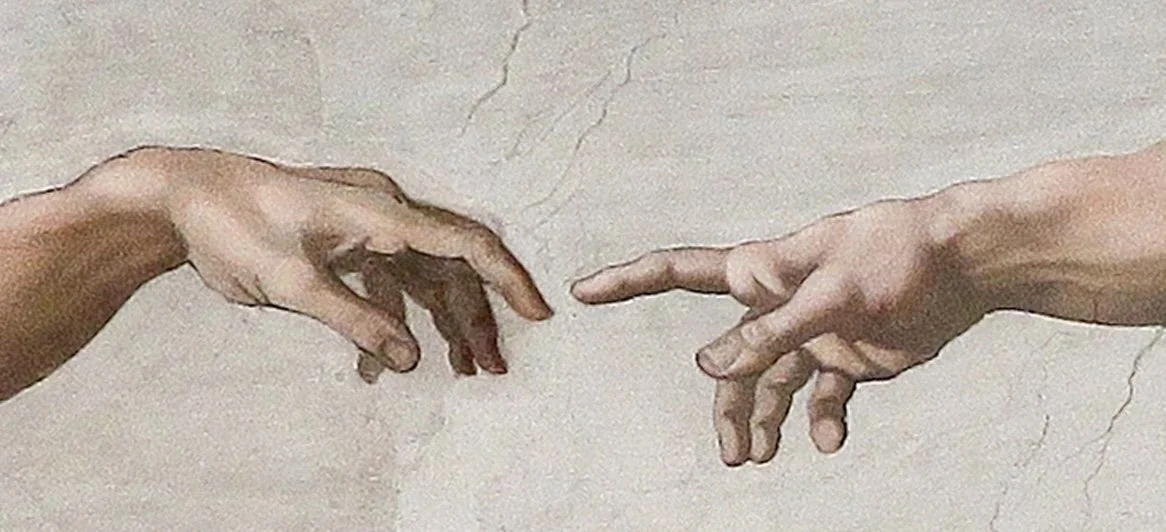
Image: Wikimedia.
Just need to get something off my chest this week.
I’ve been freelancing a bit this summer and there’s a disquieting phenomenon I’m noticing more in my own work. Even as a fairly senior writer, a big part of my job is rewriting materials provided by other people (strategists, engineers, or other “subject matter experts” (SMEs)). Much of the source material I’m given nowadays is generated by LLMs, so the job entails making it seem less like that.
This isn’t as radical a change as it might sound. For instance, I started off working in offices where English was everyone’s third or fourth language; I had to take what they said about highly technical projects and render it into something effective.
I sometimes called this “English-to-English translation” and the term still applied when I moved back to the US: despite what some engineers and salespeople thought, the source material I got was never directly usable in marketing.
So in my experience, corporate writing ^1 has always involved editing and rewriting as much as—or even more than—actual composition.
Rewriting for AI is a different set of challenges: you have to be attuned to stylistic quirks of the LLM—such as em dashes—but also to the characteristic structure of sentences: tripartite examples, “it’s not this it’s that” constructions, and so on.
It’s a bit frustrating because sometimes that punctuation or those rhetorical devices seem like the right approach to the material, but it’s still more or less analogous to the first level of the job I’ve been doing for years. It involves discernment, judgment, the editorial “fingertip feel” (Fingerspitzengefühl) for what sounds right.
This intuition supports more fulfilling work beyond the stylistic level: making sure the structure of the document holds together; that the examples support the conclusion and so on. This is not complicated—it’s stuff my kids are learning in elementary school—but AI has an unprecedented ability to string together wholly coherent sentences in largely incoherent paragraphs or sections, so it’s a different challenge than I’ve experienced until now.
So far I’ve described why this is business as usual. The disquieting part is that I don’t think this kind of work will be relevant for much longer, at least for corporate writing purposes.
The models will get better at disguising stylistic quirks
Readers of business writing will no longer expect text that doesn’t sound machine-written
Those are both guesses, but I’ll bet the audience for corporate writing will shift from interested readers (or even disinterested readers) to AI summary tools that generate a precis for someone to scan. To be honest, this has probably already happened.
If I’m right about this, the feeling I’ve gotten will become a recognized phenomenon: corporate writing will largely consist of overseeing AI tools that generate content for other AI tools to summarize. This seems, to me, a questionable use of the technology; one that’s driven by the intention of using AI in more and more contexts rather than the identification of a need that AI can fill. I’m by no means the first to notice this; Cory Doctorow already has a freaking book out on the subject (The Reverse Centaur’s Guide to Life after AI).
If something like this happens, the human role in the writing process fundamentally changes. Authors have always been responsible for their own work, but in an AI-driven system like this the human is an accountability sink: put in the loop to take the blame for any AI mistakes. ^2
I should be clear that this isn’t what I’ve personally felt so far, but I think some colleagues do, and I’ll be pleasantly astonished if the field doesn’t at least go through these throes, whether or not it settles down to a new equilibrium where corporate writing is still a thing done primarily by humans. I’m confident that writerly discernment will continue to exist—it’s essentially taste. But I’m less confident that there will be a market for it or an expectation that it’s a valuable skill for a business to hire.
I can put a positive spin on this: the people still reading will be the ones who want to read and get enjoyment from doing so, and in those cases they won’t settle for AI products because why would they. This is a version of the foundational optimism I wrote about a few months back: that a large part of the value of a creative work is the connection between the author and reader. Corporate writing, and other forms of writing where the value is in the information itself rather than the experience of reading, was in many ways a weird vestigial career: performed by discerning writers because that was the only way it could be done. AI might be able to decouple purely informational writing from a more intuitive, connected, creative sort. In the long run that might be a good thing for writing writ large, even if it’s quite painful for us writers.
Aaaaaanyway. That’s how I feel today. And to end with something that’s decidedly not paraphrasable content: my feel for this piece is that it’s like a successful paper airplane flight: starting off with a shove in the intended direction; proceeding with some wobbles and perhaps a loop, but ultimately settling out and gliding down to a conclusion that went farther than you expected.
I’m not even sure this is a universal term: I mean writing for corporate marketing or promotional purposes—not advertising but rather the range from white papers to buyer’s guides to operations manuals.
Doctorow cites Dan Davies as the originator of the term.