Explaining the joke
I perseverate. When there’s a track or a riff or a quote or an event that strikes my fancy, it somehow becomes my main aesthetic distraction for a period of time. This is how I end up playing PMJ’s cover of “Burn” 30 times in a week, or re-reminding myself that “hangry” is really a perfect portmanteau and then being mad that it was co-opted by Snickers.
I don’t think this is unusual.
But every so often one of these bits takes up long-term residence and I think that’s really just a perfect example of what someone was trying to make. And then I’m either inspired or discouraged.
For me, this happens a lot more with written phrases than with anything else—and that’s one of the reasons why I have the recurring Other Writers’ Words series. As a result, certain lines take up permanent residence in my aesthetic imagination, and represent (honestly probably just come to define) what I think of as effective and impactful and beautiful writing. This can take different forms as well:
Nabokov’s “tip of the tongue taking a trip of three steps down the palate to tap, at three, on the teeth”
Milton’s [...]if thou think, trial unsought may find
Us both securer then thus warned thou seemst,
Go; for thy stay, not free, absents thee more
But other sources are possible; Jesse Armstrong (presumably) wrote the “sails out nails out” quip for Kendall Roy in Succession and it’s not leaving my brain anytime soon.
It’s hard to describe, but to me these sentences are somehow like watching someone hit a halfcourt basketball shot, except that every time the line is enjoyed, the shot falls anew. Achieving something in writing is different than the other arts.
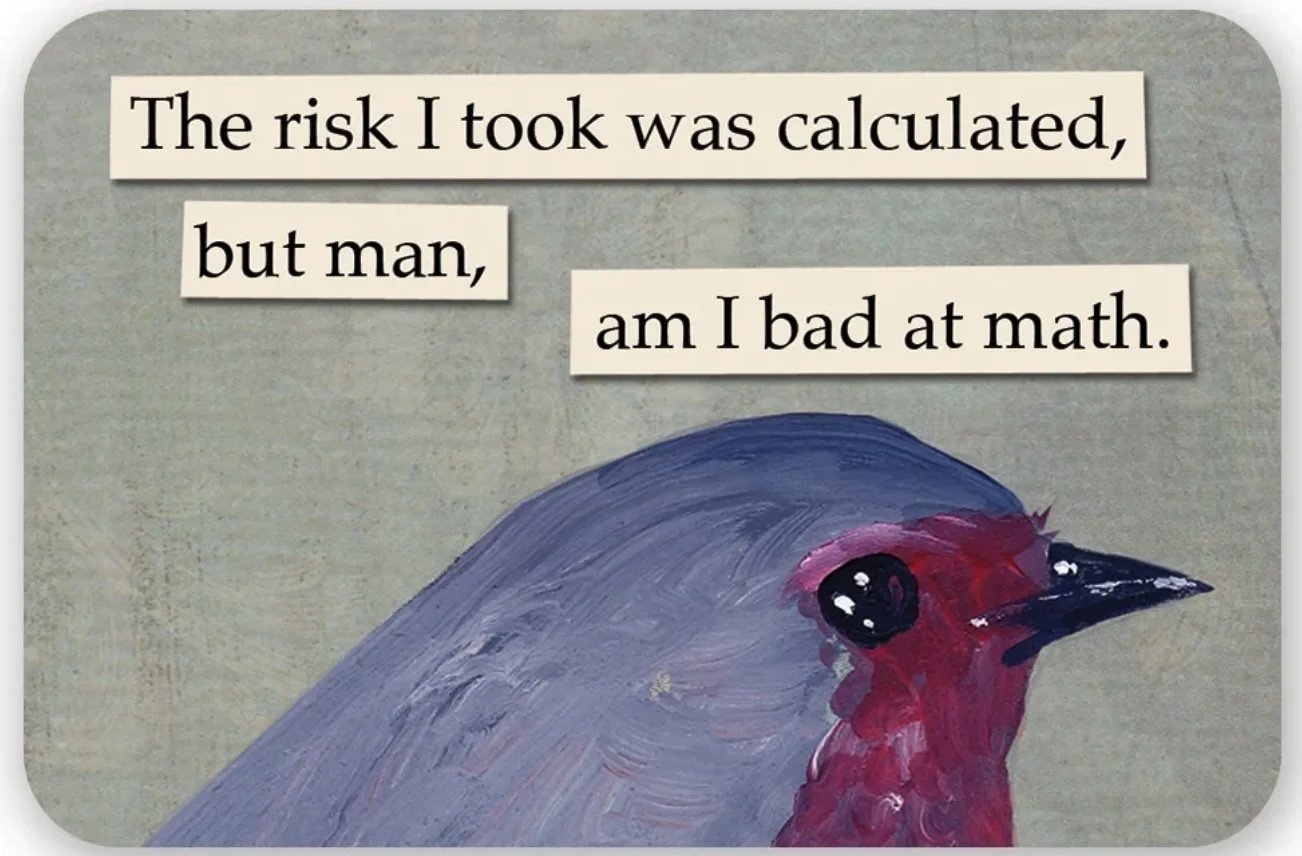
All this is a preamble to the joke in the header image—I think it has achieved a spot in my brain’s permanent collection. I’m normally awful at remembering jokes but I’m making an exception for
The risk I took was calculated,
but man,
am I bad at math.
I want to reject advice from eminent sources [1] to go into some detail about why I think this is good: not only funny but good in some more layered way. Maybe this is a way of flexing “close reading” muscles that have gone underused recently; maybe this is just an attempt to justify my falling standards for the things I find captivating, though I hope not.
First of all, despite only being 13 words long it functions like a joke, with a setup and punchline. To the extent that you can say humor consists of one thing, that thing is setting up and then subverting expectations. The final word “math” retroactively turns “calculated risk” into an unexpected literalism.
This works because it’s clearly not that serious, as confirmed by the image. This isn’t Eli Sunday choosing the wrong drilling contractor and (spoilers for There Will Be Blood) ending up dead in a bowling alley. This is a risk on the level of “I thought I could pull off a fedora.” The inclusion of “but man” is crucial to this effect, as is the bird protagonist with brimming tears in its eyes.
One further layer down, I think “calculated risk” is usually used figuratively to mean “I thought about the risks.” That’s why the subversion works. There are risks that are very well understood and accepted—for example the astronauts on the incredible Artemis II mission this year were taking risks (mainly just the one, though there were many ways to get to that bad outcome). And they’d participated in a whole team’s worth of Probabilistic Risk Assessments to define those as clearly as possible. But these aren’t really math problems; they’re engineering problems. The uncertainties have to do with understanding the systems, understanding failure modes, and putting probabilities on them. But when those are wrong (such as when the space shuttle odds of failure changed from 1 in 100,000 to 1 in 85 over successive years of testing) they’re wrong because of wrong assumptions. So even if you accept the terms of “calculating risk” literally, mathematical ability and mathematical error is the most basic and unlikely way that the calculation could go wrong.
This meme also encapsulates the endearing idea that if something bad happened it must be because I made an error, not just because of statistics. This is wrong, but understandable. If you say something has a 17% chance of happening, that seems very unlikely, but if you roll a regular die and get a 2, you don’t suddenly start asking for answers. Unlikely things happen all the time. Just not as often as likely things. But there’s this extremely human urge to think “ok, this thing that I didn’t like happened, and therefore I have to figure out what error I made along the way that led to this.” It’s somehow sweet to think that the misfortune is the result of you messing up the figures.
Going a bit deeper on that last point: it’s even wrong about the type of math error. When you claim to be bad at math it carries a sense of I didn’t calculate it correctly, but this kind of unpleasant surprise comes from not understanding statistics, i.e. not understanding how probabilities work, how you’re subject to happenstance, and how things that happen at random don’t have a moral component.
And finally, I like that the bird character responds to misfortune with humility instead of recklessness. One could imagine a statement like “I miscalculated, but oh well, YOLO, let’s go”. Instead this joke implies acceptance and maybe, just maybe, a commitment to doing better. That might be a stretch but I want to see it there.
Aaaanyway. Does this concept of risk miscalculation, in a very meta way, apply to the decision to write a whole meandering blog post about this joke? I guess we’ll see.
[1] Analyzing a joke is like dissecting a frog: no one’s that interested, and the frog dies.
- E.B White (of Charlotte’s Web fame), though I first heard it from Jimmy Carr on an episode of QI.